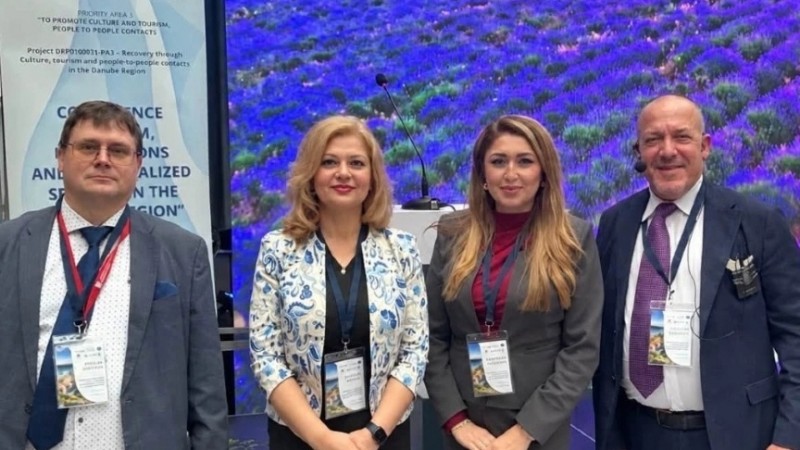
The Municipality of Ruse took part in the international conference "Tourism, Innovation, and Personalized Services in the Danube Region," held on November 4 at the Grand Hotel Millennium in Sofia under the auspices of the EU Strategy for the Danube Region (EUSDR, Priority Area 3: "Culture and Tourism"). The forum was opened by the Deputy Minister of Tourism, Prof. Dr. Mariela Modeva.
Deputy Mayor Zlatomira Stefanova participated in the panel discussion titled "Cultural Experiences: Bringing the Heritage of the Danube Region to Life." International experts—including Nedim Jašič from the UN Tourism Regional Department for Europe, Desislava Mincheva-Yordanova (Project Manager for the Interreg project "Danube Ruralscapes"), and representatives from various Danube-region institutions—also shared their best practices during the session.
Throughout the discussions, the experts emphasized that the true living heritage of the Danube consists of its people and communities. The concept of comprehensive river tourism encompasses three main areas. The first focuses on experiences *around* the river—such as cultural landmarks, museums, wine and culinary offerings, and cycling routes. The second area concerns experiences *on* the river itself—including cruises, water sports, regattas, boating, and jet skiing. The third area involves river-related events—festivals held along the banks or on the water—which generate a tangible influx of visitors.
In the context of climate change and increasingly frequent summer droughts—which restrict the operations of large cruise ships—Zlatomira Stefanova highlights the potential of small-vessel tourism as a flexible, sustainable, and promising solution for the development of the Danube region. She points to the "Danube Parade – Two Flags, One River" event—organized this year by the Municipality of Ruse in collaboration with Dan Balint from the Romanian association "Arpatia"—as a prime example. This initiative has become the largest cross-border event along the Lower Danube. The parade serves as proof that the Danube can connect people, communities, and tourist destinations in a way that large-scale infrastructure projects do not always manage to achieve. "The event demonstrated the potential of small-scale river tourism to overcome the limitations posed by low water levels, create personalized experiences, and transform the river into a vibrant space for social interaction, culture, and cooperation between Bulgaria and Romania," stated Zlatomira Stefanova.
Key measures identified for the sector's development include the construction of small urban piers and pontoons near city centers, as well as the easing of regulations regarding riverbank recreation and wild camping—modeled after the approach in Romania. Furthermore, the discussion addressed the need for the targeted inclusion of river tourism in European programs, as well as the challenge of overcoming the "brick wall" facing municipalities: the fragmented ownership structure involving the state, port infrastructure authorities, and local government.

